How to create a set of VMs using OpenStack Heat Orchestration on cloud environment
Heat is an OpenStack component responsible for orchestration. Its purpose is to provide an automation engine and optimize deployment processes.
Heat receives commands through templates, which are text files in YAML format. A template describes the infrastructure that you want to deploy. The deployed environment is called a stack and can consist of different OpenStack resources.
What We Are Going To Cover
Typical parts of a Heat template.
Basic template for using Heat.
How to get data for a Heat template.
Using Heat with CLI.
Using Heat with GUI.
More advanced template for Heat.
Prerequisites
No. 1 Account
You need a cloud environment hosting account with access to the Horizon interface: https://my.cloud.eumetsat.int.
No. 2 Installed Python and its virtualenv
If you want to use Heat through CLI commands, Python must be installed and its virtual environment activated. See article How to install Python virtualenv or virtualenvwrapper on cloud environment.
You must also authorize to OpenStack: /accountmanagement/How-to-activate-OpenStack-CLI-access-to-Eumetsat-Elasticity-cloud/How-to-activate-OpenStack-CLI-access-to-Eumetsat-Elasticity-cloud
Always use the latest value of image ID
From time to time, the default operating system images in cloud environment cloud are upgraded to new versions. As a consequence, their image ID changes. For example, the image ID for Ubuntu 20.04 LTS may have been 574fe1db-8099-4db4-a543-9e89526d20ae at the time this article was originally written. When working through the article, you should normally use the current value of the image ID instead.
If you automate OpenStack operations with Heat, Terraform, Ansible, or another automation tool, avoid hardcoding an old image ID. Once the default image is upgraded and its ID changes, automation that uses the old ID may stop working.
Warning
Make sure that your automation code uses the current value of an OS image ID, not a hardcoded historical value.
Basic template for using Heat
Using the following snippet, you can create one virtual machine booted from an ephemeral disk. Create a text file called template.yaml with your preferred text editor and save it to disk:
heat_template_version: 2015-04-30

resources:
  instance:
    type: OS::Nova::Server
    properties:
      flavor: eo1.xsmall
      image: Ubuntu 18.04 LTS
      networks:
        - network: <type in your network name here, e.g. cloud_00341_3>
        - network: <type in your network name here, e.g. eodata_00341_3>
      key_name: <type in your ssh key name>
      security_groups:
        - allow_ping_ssh_icmp_rdp
        - default
Important
YAML format does not allow tabs. Use spaces instead.
Typical parts of a Heat template
Here are the basic elements of a Heat template:
- heat_template_version
The exact version of the Heat template. Template versions vary in supported modules, parameters, customization options, and other features. You can view template versions in Orchestration → Template Versions.
- resources
Entry that starts the definition of components to be deployed.
- instance
Name of the resource. You can choose a different name.
- type
Definition of an OpenStack component. A comprehensive list is available in Orchestration → Resource Types.
- properties
Required parameters for deploying a component.
Note
Your account normally has a network starting with cloud_, but it may also have other networks. In the following examples, eodata_ is used as an example of an additional network that can be added while creating and using Heat templates.
How to get data for Heat template
Templates need data for images, flavors, networks, key pairs, security groups, and other OpenStack resources. You can usually collect this information from the relevant Horizon sections.
Template value |
Where to find it in Horizon |
|---|---|
flavor |
Compute → Instances → Launch Instance → Flavor |
image |
Compute → Instances → Launch Instance → Source |
networks |
Network → Networks, for example cloud and eodata networks for your domain |
key_name |
Compute → Key Pairs |
security_groups |
Network → Security Groups |
You can work with Heat in two ways:
through Command Line Interface (CLI), with python-heatclient installed,
interactively, through Horizon.
Using Heat with CLI
Assuming you have installed Python and activated its working environment, as explained in Prerequisite No. 2, run the pip command to install python-heatclient:
pip install python-heatclient
To run a prepared template and deploy a stack, use the following general command:
openstack stack create -t template.yaml <stackname>
In this command, -t assigns the template for deployment and <stackname> defines the name of the stack.
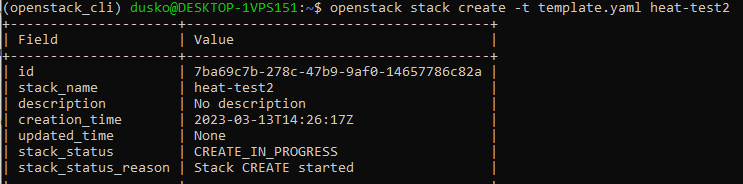
As a result, a new stack is executed and a new instance is created. For example, the command:
openstack stack create -t template.yaml heat-test2
produces output similar to this:
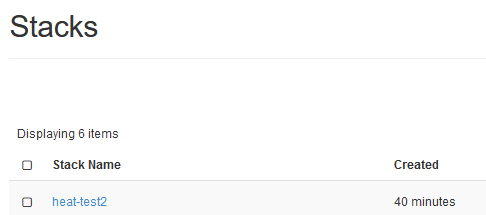
In Horizon, this is what you see under Orchestration → Stacks:
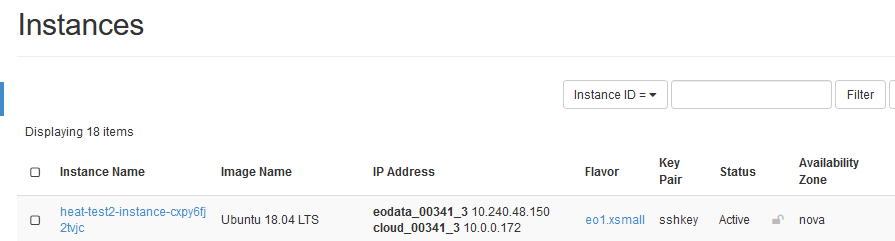
A new instance is created under Compute → Instances:
Using Heat with GUI
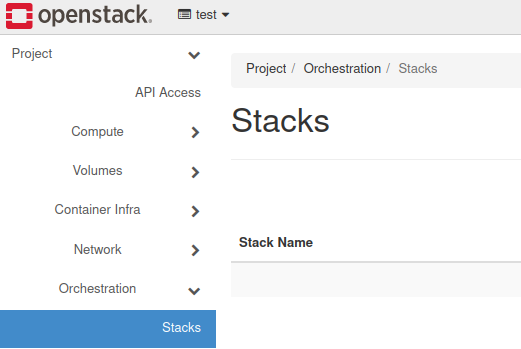
Log in to the Horizon dashboard, choose Orchestration, and then open the Stacks tab:
Navigate to the right side of the screen, click the  button, and open the Select Template window.
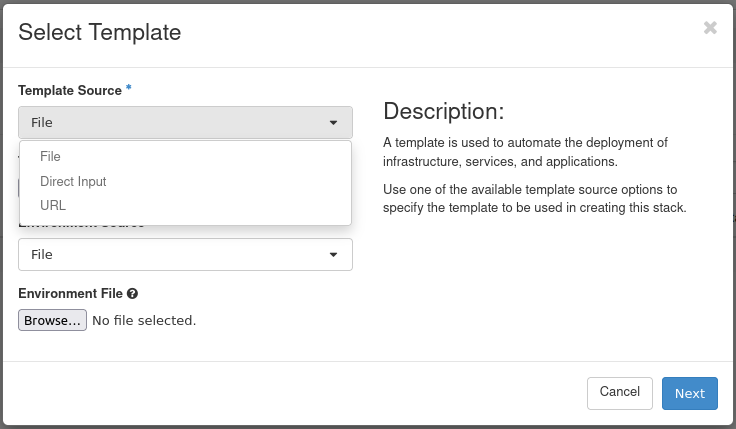
Open the Template Source selector and choose a file, direct input, or URL to your template.
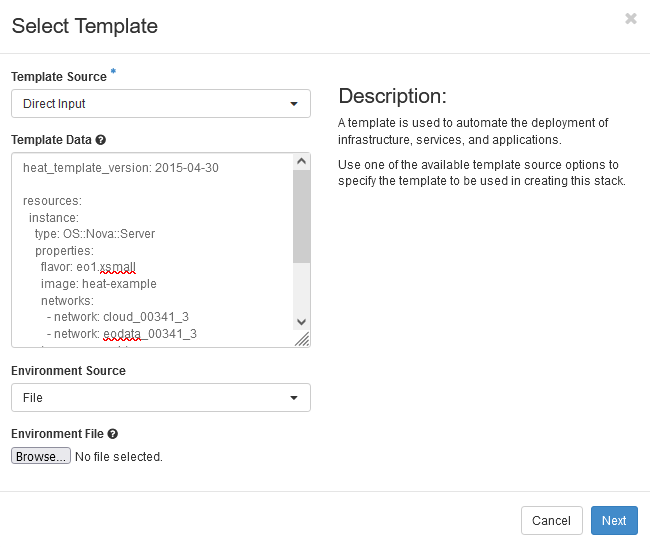
Enter the text of the template you copied from template.yaml directly into the form:
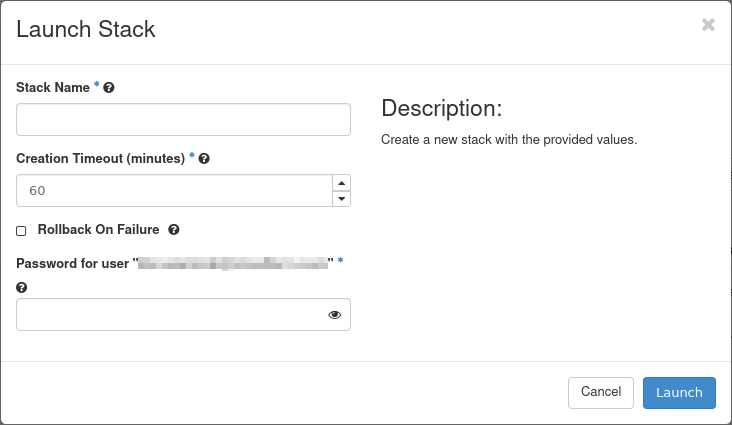
Provide a name for your stack and your OpenStack password:
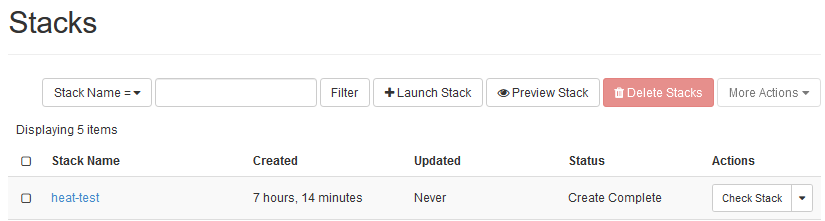
As a result, a new Heat template is created:
By creating a stack in Horizon, you also execute that template. The result is that a new instance is created. You can see it under Compute → Instances:

At this point, there are two stacks and two new instances: one created by using CLI and the other by using Horizon.
Create four VMs using an advanced Heat template
In the following example, you will attach parameters and then create a ResourceGroup with a counter, a VM booted from Cinder volume, and several predefined outputs. In parameter count, you state that you want to generate 4 instances at once. Save the following code as template4.yaml:
heat_template_version: 2015-04-30

parameters:
   key_name:
       type: string
       label: sshkey
       description: SSH key to be used for all instances
       default: <insert your ssh key name here>
   image_id:
       type: string
       description: Image to be used. Check all available options in Horizon dashboard or, with CLI, use openstack image list command.
       default: Ubuntu 18.04 LTS
   private_net_id:
       type: string
       description: ID/Name of private network
       default: <insert your network name here, e.g. cloud_00341_3>

resources:
       Group_of_VMs:
               type: OS::Heat::ResourceGroup
               properties:
                       count: 4
                       resource_def:
                               type: OS::Nova::Server
                               properties:
                                       name: my_vm%index%
                                       flavor: eo1.xsmall
                                       image: { get_param: image_id }
                                       networks:
                                               - network: { get_param: private_net_id }
                                       key_name: { get_param: key_name }
                                       security_groups:
                                               - allow_ping_ssh_icmp_rdp
                                               - default

       VOL_FAQ:
               type: OS::Cinder::Volume
               properties:
                       name: vol
                       size: 20
                       image: { get_param: image_id }

       With_volume:
               type: OS::Nova::Server
               properties:
                       flavor: eo1.xsmall
                       block_device_mapping: [{"volume_size": 20, "volume_id": { get_resource: VOL_FAQ }, "delete_on_termination": False, "device_name": "/dev/vda" }]
                       networks:
                                - network: { get_param: private_net_id }
                       key_name: { get_param: key_name }
                       security_groups:
                                - allow_ping_ssh_icmp_rdp
                                - default
                       image: { get_param: image_id }

outputs:
       SERVER_DETAILS:
               description: Shows details of all virtual servers.
               value: { get_attr: [ Group_of_VMs, show ] }
The first step is to create a real volume called VOL_FAQ. The second step is to create a VM called With_volume.
Explanation
- Parameters
Here you provide default values, such as key_name, image_id, and private_net_id, and later inject them into resource definitions. The syntax is:
{ get_param: param_name }- ResourceGroup
Component used for repeated deployment, for example two or more identical VMs.
- Count
Defines a variable for iterative operations.
- resource_def
Starting statement for defining group resources.
- %index%
Adds an iterative number to the VM name, increasing values starting from 0.
- block_device_mapping
Property used to define a bootable Cinder volume for an instance.
- outputs
Additional information concerning deployed elements of the stack. In this case, it returns a show attribute output. You can examine this kind of information by using openstack stack output list. Available attributes for every component can be found here.
Execute the template with the following command:
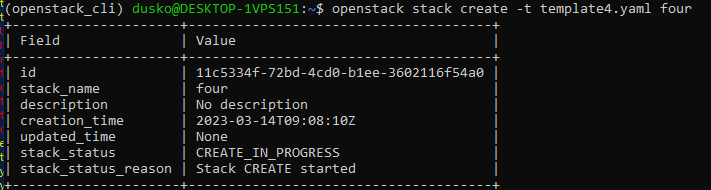
openstack stack create -t template4.yaml four
The name of the stack is four. This is the result in the CLI window:
Under Compute → Instances, you see five new instances:
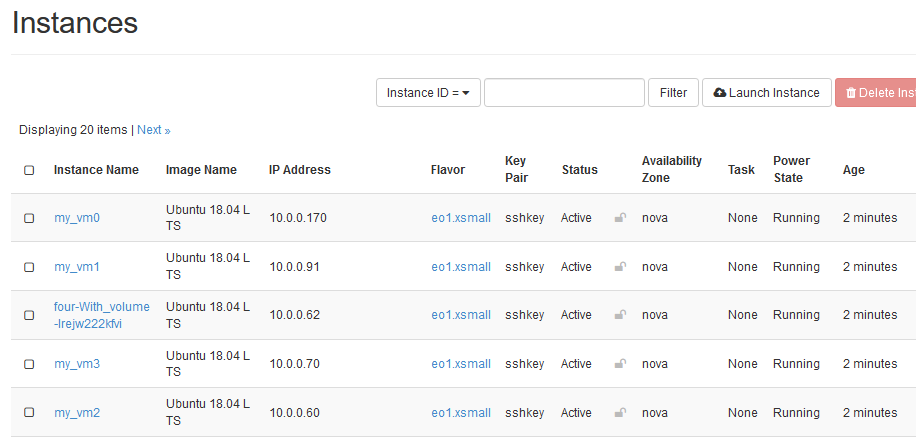
Four of them have names my_vm0, my_vm1, my_vm2, and my_vm3, as defined in line name: my_vm%index% in the template. The fifth is called four-With_volume-lrejw222kfvi. Its name starts with the stack name, while the rest is generated automatically.
What To Do Next
You can write your own templates as YAML files, or you can use Orchestration → Template Generator to enter components interactively:
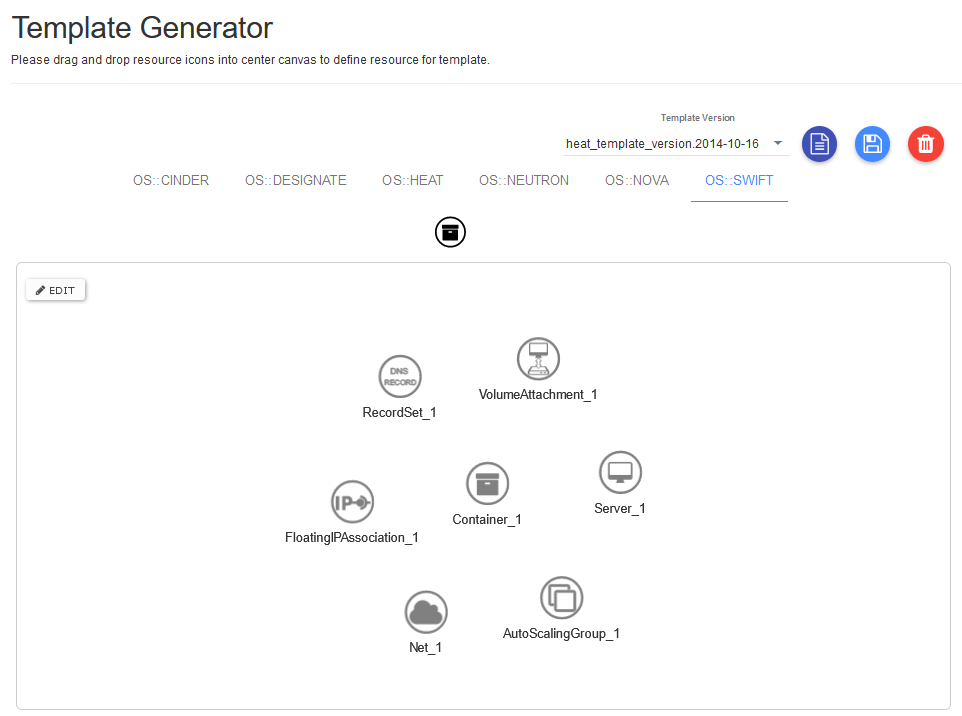
Further explanation of this option is outside the scope of this article.